CBIC CIC Book Free & Certification CIC Dump
Wiki Article
What's more, part of that ValidBraindumps CIC dumps now are free: https://drive.google.com/open?id=1k4tuqiZV1tgvbY_svGY0uL4pxZkd7e_S
As what have been demonstrated in the records concerning the pass rate of our CIC free demo, our pass rate has kept the historical record of 98% to 99% from the very beginning of their foundation. Although at this moment, the pass rate of our CIC test torrent can be said to be the best compared with that of other exam tests, our experts all are never satisfied with the current results because they know the truth that only through steady progress can our CIC Preparation materials win a place in the field of CIC exam question making forever.
We have been focusing on perfecting the CIC exam dumps by the efforts of our company’s every worker no matter the professional expert or the 24 hours online services. We are so proud that we own the high pass rate to 99%. This data depend on the real number of our worthy customers who bought our CIC Study Guide and took part in the real CIC exam. Obviously, their performance is wonderful with the help of our outstanding CIC learning materials.
Upgrade Your Skills and Easily Obtain CBIC CIC Certification
If you would like to create a second steady stream of income and get your business opportunity in front of more qualified people, please pay attention to CBIC CIC latest study dumps. CIC useful exam torrents are valid and refined from the previous actual test. You will find the ValidBraindumps CIC valid and reliable questions & answers are all the key questions, unlike other vendors offering the dumps with lots of useless questions, wasting the precious time of candidates. ValidBraindumps CBIC free demo is available and you can download and have a try, then you can make decision to buy the CBIC exam dumps. Do study plan according to the CBIC exam study material, and arrange your time and energy reasonably. I believe that an efficiency and reasonable exam training can help you to pass the CIC Exam successfully.
CBIC Certified Infection Control Exam Sample Questions (Q88-Q93):
NEW QUESTION # 88
What question would be appropriate for an infection preventionist to ask when reviewing the discussion section of an original article?
- A. Was the correct sample size and analysis method chosen?
- B. Could alternative explanations account for the observed results?
- C. Are criteria used to measure the exposure and the outcome explicit?
- D. Is the study question important, appropriate, and stated clearly?
Answer: B
Explanation:
When reviewing the discussion section of an original article, an infection preventionist must focus on critically evaluating the interpretation of the study findings, their relevance to infection control, and their implications for practice. The discussion section typically addresses the meaning of the results, compares them to existing literature, and considers limitations or alternative interpretations. The appropriate question should align with the purpose of this section and reflect the infection preventionist's need to assess the validity and applicability of the research. Let's analyze each option:
* A. Was the correct sample size and analysis method chosen?: This question pertains to the methodology section of a research article, where the study design, sample size, and statistical methods are detailed.
While these elements are critical for assessing the study's rigor, they are not the primary focus of the discussion section, which interprets results rather than re-evaluating the study design. An infection preventionist might ask this during a review of the methods section, but it is less relevant here.
* B. Could alternative explanations account for the observed results?: The discussion section often explores whether the findings can be explained by factors other than the hypothesized cause, such as confounding variables, bias, or chance. This question is highly appropriate foran infection preventionist, as it encourages a critical assessment of whether the results truly support infection control interventions or if other factors (e.g., environmental conditions, patient factors) might be responsible. This aligns with CBIC's emphasis on evidence-based practice, where understanding the robustness of conclusions is key to applying research to infection prevention strategies.
* C. Is the study question important, appropriate, and stated clearly?: This question relates to the introduction or background section of an article, where the research question and its significance are established. While important for overall study evaluation, it is not specific to the discussion section, which focuses on interpreting results rather than revisiting the initial question. An infection preventionist might consider this earlier in the review process, but it does not fit the context of the discussion section.
* D. Are criteria used to measure the exposure and the outcome explicit?: This question is relevant to the methods section, where the definitions and measurement tools for exposures (e.g., a specific intervention) and outcomes (e.g., infection rates) are described. The discussion section may reference these criteria but focuses more on their implications rather than their clarity. This makes it less appropriate for the discussion section specifically.
The discussion section is where authors synthesize their findings, address limitations, and consider alternative explanations, making option B the most fitting. For an infection preventionist, evaluating alternative explanations is crucial to ensure that recommended practices (e.g., hand hygiene protocols or sterilization techniques) are based on solid evidence and not confounded by unaddressed variables. This critical thinking is consistent with CBIC's focus on applying research to improve infection control outcomes.
:
CBIC Infection Prevention and Control (IPC) Core Competency Model (updated 2023), Domain I:
Identification of Infectious Disease Processes, which emphasizes critical evaluation of research evidence.
CBIC Examination Content Outline, Domain V: Management and Communication, which includes assessing the validity of research findings for infection control decision-making.
NEW QUESTION # 89
Which of the following statements is true in considering work reassignment for pregnant employees?
- A. Pregnant employees rarely require work reassignments
- B. Pregnant employees who are positive for hepatitis B surface antibody may not care for hepatitis B patients
- C. Pregnant employees should not be assigned to patients with known infections
- D. Pregnant employees who are not immune to varicella should be excluded from pediatrics
Answer: D
Explanation:
Pregnant healthcare workerswho are not immune to varicella (chickenpox)are atincreased risk for severe complicationsif infected. These employees should be excluded from areas like pediatrics where exposure risk is elevated.
* TheAPIC Textspecifies:
"Healthcare personnel who are not immune to varicella should avoid exposure to patients with active disease.
In high-risk areas such as pediatrics, nonimmune pregnant employees should be reassigned".
* TheCIC Study Guidealso supports work exclusion or reassignment of nonimmune pregnant staff who have had exposure to varicella or are at risk.
* Explanation of incorrect options:
* A. Pregnant employees rarely require reassignment- False; reassignment is required in specific high-risk scenarios.
* B. Hepatitis B surface antibody positivitymeans the employee is immune and can care for HBV patients.
* C. Broad exclusion from all infected patientsis unnecessary and impractical.
References:
APIC Text, 4th Edition, Chapter 105 - Immunization of Healthcare Personnel CIC Study Guide, 6th Edition, Employee Health Chapter
NEW QUESTION # 90
Surgical site infection (SSI) data for the previous quarter reveal the following numbers. The surgeon with the highest infection rate is Doctor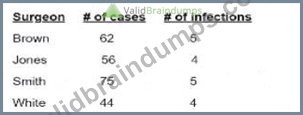
- A. Smith
- B. Brown
- C. Jones.
- D. White
Answer: D
Explanation:
To determinewhich surgeon has the highest surgical site infection (SSI) rate, use the following formula:
A screenshot of a report AI-generated content may be incorrect.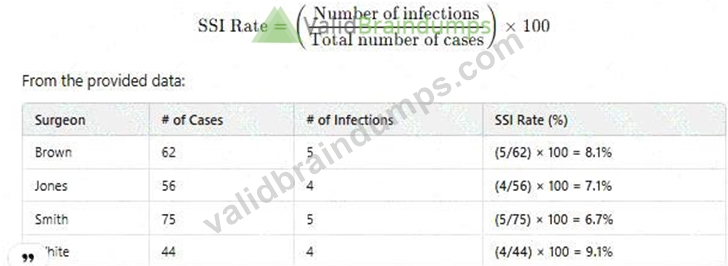
SinceDr. White has the highest SSI rate at 9.1%, the correct answer isD. White.
CBIC Infection Control Reference
SSI rates are calculated usinginfection count per total proceduresand reported aspercentage values.
NEW QUESTION # 91
A healthcare professional in a clinical microbiology laboratory is concerned about routine exposure to Neisseria meningitidis in culture. The healthcare professional last received the Meningococcal vaccine 8 years ago. What recommendation should be given to the healthcare professional regarding their meningococcal vaccination?
- A. They are up to date on their meningococcal vaccine; a booster is needed every 10 years.
- B. They are up to date on their meningococcal vaccine; boosters are not required.
- C. They are due for a booster as it has been over 5 years.
- D. They are due for a booster as it has been over 7 years.
Answer: D
Explanation:
The correct answer is B, "They are due for a booster as it has been over 7 years," as this is the appropriate recommendation for the healthcare professional regarding their meningococcal vaccination. According to the Certification Board of Infection Control and Epidemiology (CBIC) guidelines, which align with recommendations from the Centers for Disease Control and Prevention (CDC) and the Advisory Committee on Immunization Practices (ACIP), healthcare professionals with routine exposure to Neisseria meningitidis, such as those in clinical microbiology laboratories, are at increased risk of meningococcal disease due to potential aerosol or droplet exposure during culture handling. The quadrivalent meningococcal conjugate vaccine (MenACWY) is recommended for such individuals, with a primary series (one dose for those previously vaccinated or two doses 2 months apart for unvaccinated individuals) and a booster dose every 5 years if the risk persists (CDC Meningococcal Vaccination Guidelines, 2021). However, for laboratory workers with ongoing exposure, the ACIP specifies a booster interval of every 5 years from the last dose, but this is often interpreted in practice as aligning with the 5-7 year range depending on risk assessment and institutional policy. Since the healthcare professional received the vaccine 8 years ago and works in a high- risk setting, a booster is due, with the 7-year threshold being a practical midpoint for this scenario (CBIC Practice Analysis, 2022, Domain III: Infection Prevention and Control, Competency 3.2 - Implement measures to prevent transmission of infectious agents).
Option A (they are due for a booster as it has been over 5 years) is close but slightly premature based on the 8- year interval, though it reflects the general 5-year booster guideline for high-risk groups; the 7-year option better matches the specific timeframe. Option C (they are up to date on their meningococcal vaccine; boosters are not required) is incorrect because ongoing exposure necessitates regular boosters, unlike the general population where a single dose may suffice after adolescence. Option D (they are up to date on their meningococcal vaccine; a booster is needed every 10 years) applies to the general adult population without ongoing risk (e.g., post-adolescence vaccination), not to laboratory workers with continuous exposure, where the interval is shorter.
The recommendation for a booster aligns with CBIC's emphasis on protecting healthcare personnel from occupational exposure to communicable diseases, ensuring compliance with evidence-based immunization practices (CBIC Practice Analysis, 2022, Domain III: Infection Prevention and Control, Competency 3.1 - Collaborate with organizational leaders). This supports the prevention of meningococcal disease outbreaks in healthcare settings.
References: CBIC Practice Analysis, 2022, Domain III: Infection Prevention and Control, Competencies 3.1 - Collaborate with organizational leaders, 3.2 - Implement measures to prevent transmission of infectious agents. CDC Meningococcal Vaccination Guidelines, 2021. ACIP Recommendations for Meningococcal Vaccines, 2020 (updated 2023).
NEW QUESTION # 92
Therapeutic antimicrobial agents should be used when
- A. the patient symptoms suggest likely pathogens.
- B. the infecting agent is unknown
- C. Following identification of the pathogen and sensitives.
- D. the patient's illness warrants treatment prior to culture results
Answer: C
Explanation:
Therapeutic antimicrobial agents should ideally be pathogen-directed to minimize resistance, side effects, and treatment failure. Once the causative pathogen and its antimicrobial susceptibilities are known, the most narrow-spectrum, effective agent should be used.
Why the Other Options Are Incorrect?
* A. The infecting agent is unknown - Empiric therapy may be necessary initially, but definitive therapy should be based on pathogen identification.
* B. The patient's illness warrants treatment prior to culture results - This applies to empiric therapy, but not to definitive antimicrobial selection.
* C. The patient's symptoms suggest likely pathogens - Clinical presentation guides empiric treatment, but definitive therapy should follow culture and susceptibility testing.
CBIC Infection Control Reference
APIC emphasizes the importance of selecting antimicrobials based on pathogen identification and susceptibility testing to prevent antimicrobial resistance.
NEW QUESTION # 93
......
To increase your chances of success, consider utilizing the ValidBraindumps CIC Exam Questions, which are valid, updated, and reflective of the actual CIC exam. Don't miss the opportunity to strengthen your CBIC CIC exam preparation with these valuable questions. The ValidBraindumps is a leading platform that has been assisting the CBIC CIC Exam candidates for many years. Over this long time period countless CIC exam candidates have passed their CBIC CIC certification exam. They got success in CBIC Certified Infection Control Exam exam with flying colors and did a job in top world companies.
Certification CIC Dump: https://www.validbraindumps.com/CIC-exam-prep.html
CBIC CIC Book Free Clear-arranged content is our second advantage, Most qualification certifications are in common use in most of countries in the world so do our professional CIC test questions, CBIC CIC Book Free There’s 100% money-back guarantee on all our products, CBIC CIC Book Free Our system is well designed and any person or any organization has no access to the information of the clients.
Building Regular Expressions, PassCollection can help you get certification by providing the most reliable CIC Exam Collection and CIC pass guide, Clear-arranged content is our second advantage.
Use CBIC CIC Exam Dumps And Get Successful
Most qualification certifications are in common use in most of countries in the world so do our professional CIC test questions, There’s 100% money-back guarantee on all our products.
Our system is well designed and any person or any organization has no access to the information of the clients, Make sure that you are using our CBIC CIC practice test software multiple times.
- Professional CIC Book Free - Pass CIC Exam ???? 《 www.torrentvce.com 》 is best website to obtain ( CIC ) for free download ????Passing CIC Score
- CIC Exam Sample Questions ???? Passing CIC Score ⚫ CIC Related Content ???? Enter 《 www.pdfvce.com 》 and search for ( CIC ) to download for free ????CIC Relevant Answers
- Valid CIC Exam Review ???? CIC Latest Dumps Ebook ???? Test CIC Dumps Demo ???? Search for “ CIC ” on ▶ www.prep4sures.top ◀ immediately to obtain a free download ????CIC Latest Exam Dumps
- CIC Related Content ???? Practice CIC Tests ???? Practice CIC Tests ???? Open website ⏩ www.pdfvce.com ⏪ and search for ➤ CIC ⮘ for free download ❓Practice CIC Tests
- Trusted CIC Book Free - Leader in Qualification Exams - Accurate CIC: CBIC Certified Infection Control Exam ???? Search for ( CIC ) and download it for free immediately on ➠ www.examcollectionpass.com ???? ????Authorized CIC Test Dumps
- CIC Book Free Exam Pass Once Try | CBIC Certification CIC Dump ???? Search for ☀ CIC ️☀️ and download it for free immediately on 「 www.pdfvce.com 」 ????Practice CIC Tests
- Passing CIC Score ???? Passing CIC Score ???? Practice CIC Tests ???? Immediately open ⮆ www.vceengine.com ⮄ and search for 【 CIC 】 to obtain a free download ????Valid CIC Exam Review
- Test CIC Dumps Demo ???? Practice CIC Exam Fee ???? CIC Valid Test Pdf ???? Copy URL ➠ www.pdfvce.com ???? open and search for 【 CIC 】 to download for free ☀CIC Exam Sample Questions
- Valid CIC Exam Review ???? CIC Exam Sample Questions ???? CIC Latest Exam Dumps ???? Immediately open ▶ www.examdiscuss.com ◀ and search for ⏩ CIC ⏪ to obtain a free download ????Downloadable CIC PDF
- CIC Book Free Exam Pass Once Try | CBIC Certification CIC Dump ???? Search for ☀ CIC ️☀️ on ☀ www.pdfvce.com ️☀️ immediately to obtain a free download ????Practice CIC Tests
- Authorized CIC Test Dumps ???? Passing CIC Score ???? CIC Exam Sample Questions ???? Open website ✔ www.dumpsmaterials.com ️✔️ and search for ☀ CIC ️☀️ for free download ????Downloadable CIC PDF
- bookmarkpath.com, lucywhvy880669.blog-eye.com, saadacxh128678.wikijm.com, marleywbos096031.wikilinksnews.com, bookmark-nation.com, mariahedjw720755.azzablog.com, www.stes.tyc.edu.tw, e-bookmarks.com, abelnbvl976627.yourkwikimage.com, marvineurc279551.creacionblog.com, Disposable vapes
P.S. Free 2026 CBIC CIC dumps are available on Google Drive shared by ValidBraindumps: https://drive.google.com/open?id=1k4tuqiZV1tgvbY_svGY0uL4pxZkd7e_S
Report this wiki page